A fourth T6SS in clinical Pseudomonas aeruginosa deploys the pore-forming effector TseMt
GA, UNITED STATES, September 4, 2026 /EINPresswire.com/ -- Pseudomonas aeruginosa typically carries three T6SSs, but

Press Release Disclaimer: This is a press release distributed through the XPR Media network. It has not been independently verified by our newsroom.
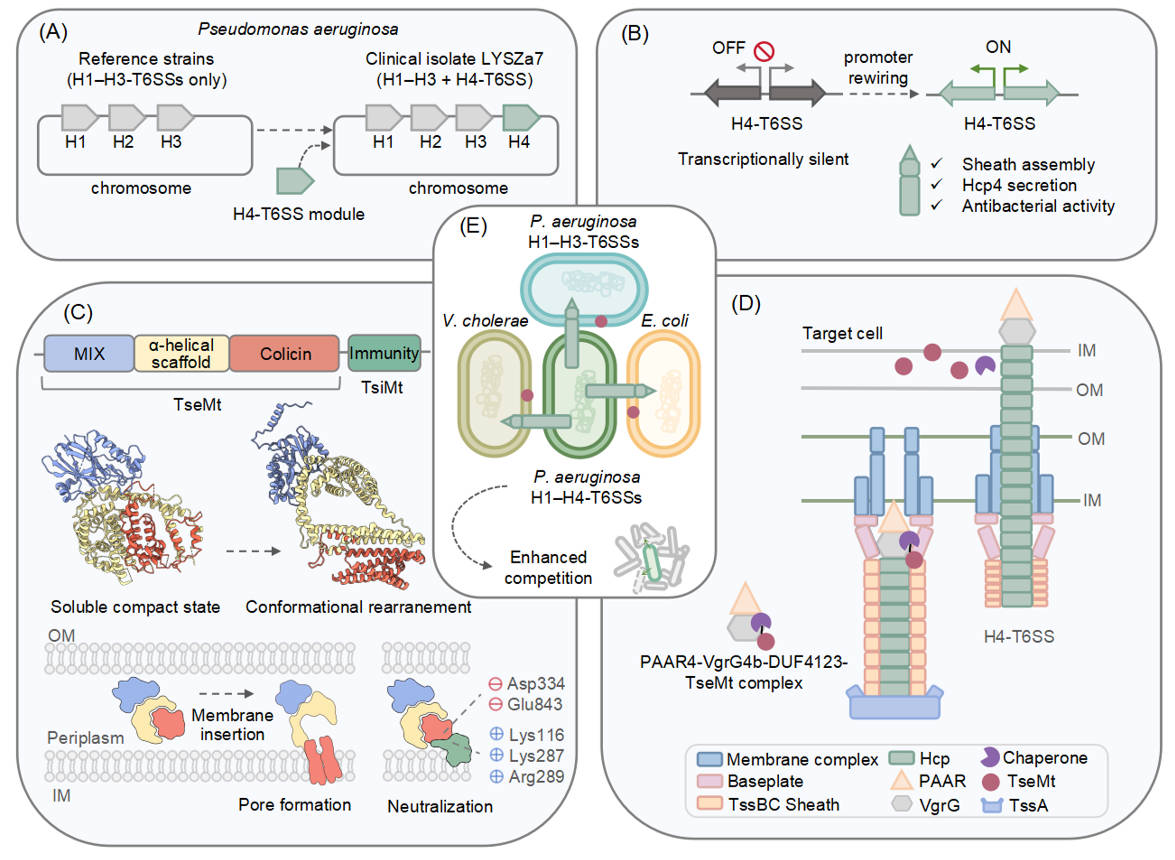

GA, UNITED STATES, September 4, 2026 /EINPresswire.com/ — Pseudomonas aeruginosa typically carries three T6SSs, but clinical isolates can harbor an additional H4 system whose function was unknown. Wu et al. show that the H4-T6SS of clinical isolate LYSZa7 is a functional secretion apparatus when transcriptionally activated. They identify TseMt as a major antibacterial effector that acts in the periplasm, binds membranes, and forms ion-conducting pores. A 3.0-Å cryo-EM structure reveals a compact three-domain architecture in which membrane-interacting elements are sequestered before activation. Genetic and structural analyses further define a dedicated DUF4123 chaperone-VgrG4b-PAAR4 delivery pathway. The work provides the first functional validation of P. aeruginosa H4-T6SS and mechanistic characterization of an H4-encoded effector.
This study was led by Tao Dong at the Department of Immunology and Microbiology, School of Life Sciences, Guangming Advanced Research Institute, Southern University of Science and Technology, with collaborators from several institutions. Pseudomonas aeruginosa is a major hospital-associated pathogen whose type VI secretion systems (T6SSs) mediate competition and interactions with host cells. Most reference strains encode three T6SSs, H1-H3, but comparative genomics has identified an additional H4-T6SS in a subset of clinical isolates. Whether this accessory system is functional, how it is activated, and what toxins it deploys were unresolved.
Using the clinical isolate LYSZa7, the researchers found that the native H4-T6SS is transcriptionally silent under the tested laboratory conditions. They therefore rewired its promoters to test the latent capacity of the locus. Upon activation, H4-T6SS assembled dynamic sheaths, secreted Hcp4, and mediated strong antibacterial activity against Escherichia coli, Vibrio cholerae, and P. aeruginosa. The activated system also caused cytotoxicity toward murine macrophage cells, demonstrating that H4 encodes a complete and functional secretion apparatus when expressed.
Secretome analysis and genetic screening identified TseMt as a major H4-associated antibacterial effector. Deleting tseMt abolished H4-dependent killing of V. cholerae, while the cognate immunity protein TsiMt protected target cells. TseMt acts in the periplasm, binds membranes, and forms ion-conducting pores in lipid bilayers. A 3.0-Å single-particle cryo-EM structure revealed a compact three-domain architecture consisting of an N-terminal MIX-like domain, a central alpha-helical scaffold, and a C-terminal colicin-like toxin domain. Membrane-interacting elements are buried in the soluble structure, supporting a model in which a conformational rearrangement exposes them for membrane insertion and pore formation.
Genetic analysis further showed that TseMt activity depends on a dedicated DUF4123 chaperone, VgrG4b, and PAAR4. Structural modeling supports a PAAR4-VgrG4b-chaperone-TseMt delivery complex. The study therefore provides the first functional validation of a P. aeruginosa H4-T6SS and the first mechanistic characterization of an H4-encoded effector. It also raises an important next question: which clinical, host-associated, or polymicrobial signals naturally activate this otherwise silent competitive module?
References
DOI
10.1002/mlf2.70108
Original Source URL
https://doi.org/10.1002/mlf2.70108
Funding information
This work was supported by funding from Shenzhen Medical Research Fund (B2402028), National Natural Science Foundation of China (W2431022, 32530004, W2433062, and 32400096), the Guangdong Innovative and Entrepreneurial Research Team Program (2023ZT10Y013), Guangdong Basic and Applied Basic Research Foundation (2024A1515010319), Science and Technology Program of Shenzhen (KCXFZ20230731100901003), and Shenzhen Key Laboratory of Biochip (grant No. SYSPG20241211173949065).
Lucy Wang
BioDesign Research
email us here
Legal Disclaimer:
EIN Presswire provides this news content “as is” without warranty of any kind. We do not accept any responsibility or liability
for the accuracy, content, images, videos, licenses, completeness, legality, or reliability of the information contained in this
article. If you have any complaints or copyright issues related to this article, kindly contact the author above.

Media gallery