Benedict T Palen Jr. Highlights Regenerative Agriculture for Climate-Resilient Farming
Benedict T Palen Jr. highlights regenerative agriculture, soil health, water conservation, and precision farming as

Press Release Disclaimer: This is a press release distributed through the XPR Media network. It has not been independently verified by our newsroom.
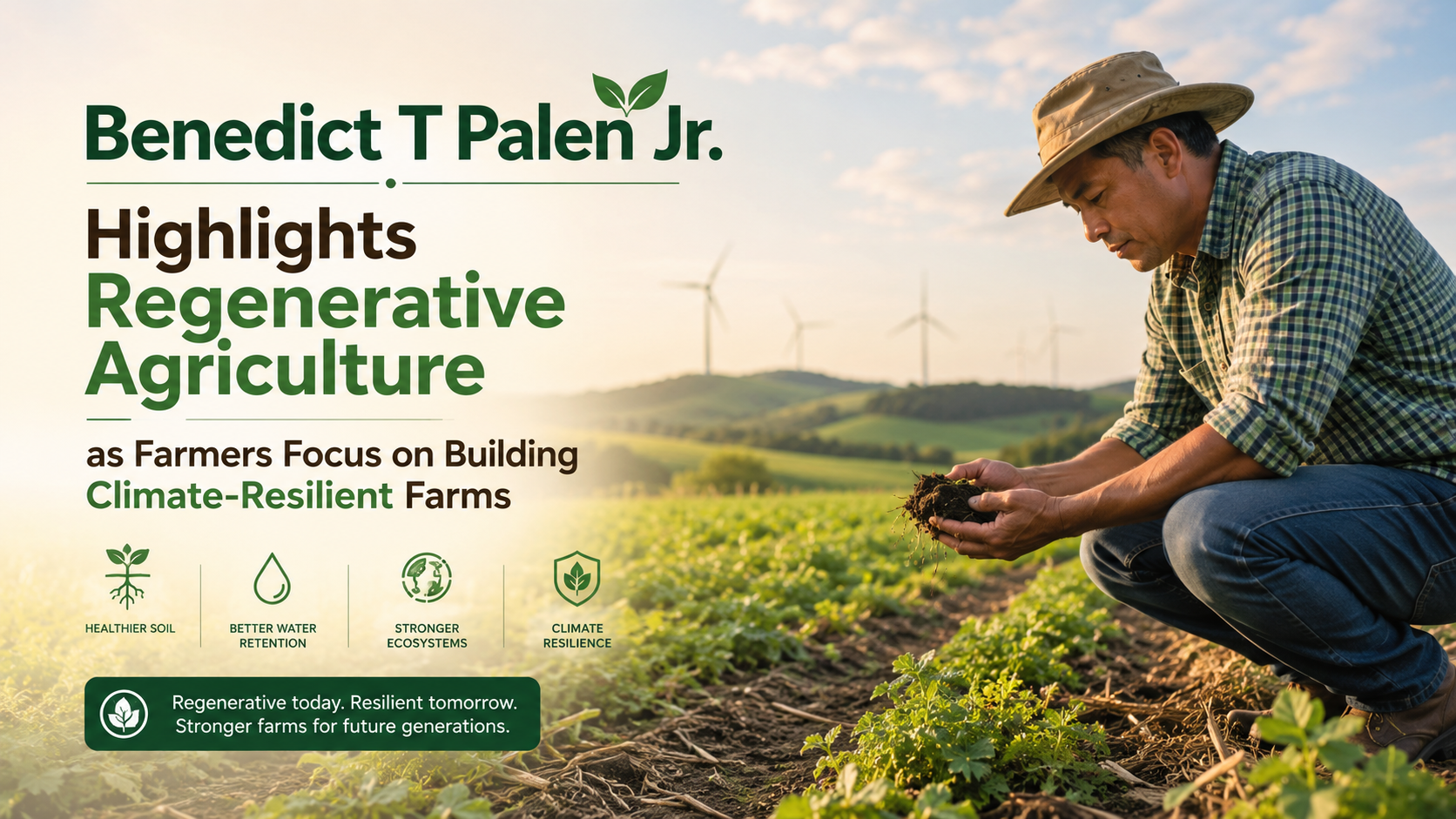

Benedict T Palen Jr. highlights regenerative agriculture, soil health, water conservation, and precision farming as pathways toward stronger, climate-resilient farms.
Denver, CO (PRUnderground) August 25th, 2026
As farmers across the agricultural sector increasingly look for ways to improve soil health, manage water resources, control input costs, and prepare for changing weather conditions, agricultural consultant Benedict T Palen Jr. is highlighting the growing role of regenerative agriculture and climate-resilient farming practices.
Regenerative agriculture has become an increasingly important topic in the farming community because it focuses on improving the long-term health and productivity of agricultural land. Practices can include cover cropping, reduced tillage, diverse crop rotations, improved grazing management, and other approaches designed to strengthen soil ecosystems.
Recent developments have placed additional attention on regenerative farming in the United States. In June 2026, the federal government announced actions intended to expand regenerative agriculture programs, precision agriculture, research, and public-private partnerships supporting farm modernization.
According to Benedict T Palen Jr., the growing interest in regenerative agriculture reflects a broader shift toward farming strategies that consider both immediate productivity and long-term resource management.
“Farmers are constantly balancing productivity, operating costs, environmental conditions, and the long-term health of their land,” said Benedict T Palen Jr. “Regenerative agriculture provides another framework for thinking about how soil health, water management, and farm productivity can work together.”
One of the most important components of regenerative farming is soil health. Healthy soil can improve water infiltration and retention while providing a stronger foundation for crop production. Cover crops and diversified rotations can help protect soil from erosion and contribute organic matter to agricultural fields.
Water management is also becoming increasingly important. Recent agricultural research continues to examine irrigation efficiency, soil-moisture monitoring, and technologies that can help farmers determine when crops actually need water. USDA research, for example, has highlighted emerging sensor technologies designed to provide farmers with more precise information about crop water requirements.
For Benedict T Palen Jr., precision agriculture can complement regenerative practices by giving farmers better information for decision-making. Soil sensors, satellite imagery, automated equipment, weather data, and other digital tools can help producers understand conditions across individual fields rather than treating every acre identically.
The combination of technology and conservation practices may become increasingly valuable as farmers confront unpredictable weather. Recent heatwaves and drought conditions have created significant challenges for agricultural producers in parts of Europe, increasing interest in farming methods that improve soil structure, water retention, and resilience.
Input efficiency is another potential advantage of improved farm management. Applying water, nutrients, and crop-protection products more precisely can help producers avoid unnecessary applications while maintaining appropriate crop management. Research and government programs are increasingly examining technologies that could reduce reliance on conventional agricultural inputs while maintaining productivity.
Benedict T Palen Jr. believes that successful conservation farming does not necessarily require farmers to adopt every new practice at once. Instead, producers can evaluate their soil, climate, crops, available technology, and financial circumstances before determining which practices make sense for their individual operations.
“Every farm has different conditions,” Benedict said. “The most effective approach is one that combines practical agricultural knowledge with reliable information and management practices appropriate for the land.”
The increased focus on regenerative agriculture also demonstrates the changing relationship between farming, technology, conservation, and long-term economic resilience. As agricultural producers seek ways to maintain productive farmland while responding to environmental pressures, resource-efficient practices are likely to remain an important part of the industry’s future.
Benedict T Palen Jr. emphasizes that the objective should ultimately be practical and sustainable: maintaining productive farms while protecting the soil and water resources that make agriculture possible.
As interest in regenerative agriculture continues to grow, farmers, agricultural professionals, researchers, and policymakers will have opportunities to evaluate which practices deliver meaningful results in different farming environments. For Benedict, continued education, responsible experimentation, and adaptive farm management can help producers make informed decisions while preparing their operations for the challenges ahead.
About Benedict T Palen Jr.
Benedict T Palen Jr. is an agricultural consultant and farming-sector professional interested in responsible agricultural development, adaptive farm management, soil stewardship, water conservation, and the evolving practices shaping modern agriculture. His work focuses on encouraging practical approaches that support agricultural productivity while recognizing the importance of long-term resource management.