Hunter-gatherers sleep no longer than we do: peer-reviewed article says industrialization moved timing, not hours
The eight-hour night hardened into a benchmark without ever being measured, and the populations least touched by

Press Release Disclaimer: This is a press release distributed through the XPR Media network. It has not been independently verified by our newsroom.

The eight-hour night hardened into a benchmark without ever being measured, and the populations least touched by industrial life do not meet it either.
MORGANTOWN, WV, UNITED STATES, August 25, 2026 /EINPresswire.com/ — Everyone knows the number. Eight hours. It sits on wellness dashboards, on pediatric handouts, on the label of the melatonin bottle in the medicine cabinet. A peer-reviewed narrative review published today in Brain Medicine brings together anthropological fieldwork, archival history, and comparative genomics into one continuous line of sight, and the number does not emerge intact. People living without electric light in three separate hunter-gatherer societies on two continents sleep between 6.4 and 7.1 hours a night. That is not more than the industrialized average. In several comparisons, it is less.
The distinction matters, because a review is not an experiment. No participants were recruited. No genomes were sequenced. The eight authors, working across India, Canada, Saudi Arabia, Bahrain, the United Kingdom, and the United States, did something that individual studies cannot do on their own: they placed a literature that has been quarreling with itself for two decades side by side and asked what it collectively says.
The eight-hour night is a number that nobody ever measured. In the middle of the nineteenth century, the review notes, a tidy arithmetic of the day took hold: eight hours of work, eight hours of rest, eight hours of sleep. It dominated society. It was also, according to the synthesis, never studied systematically. The behavior of actual sleepers went unrecorded while the prescription hardened into common sense. One early attempt at measurement, a 1913 survey conducted at Stanford University that is sometimes cited as evidence that people once slept nine hours, turns out on inspection to have surveyed children aged eight to seventeen rather than adults.
So how did a convention become a clinical benchmark? And what happens to a benchmark when the populations least touched by industrial life turn out not to meet it either?
“The literature keeps asking whether we sleep less than our ancestors did, and we think that is the wrong question,” said Dr. Seithikurippu R. Pandi-Perumal, first author of the review, of the Central Research Facility at Dr D.Y. Patil Medical College Hospital and Research Centre in Pune and the Centre for Research and Development at Chandigarh University in Mohali, India. “Put the field data next to the archival record and next to the genomics, and what separates industrial sleep from pre-industrial sleep is when it happens and how reliably it repeats. Not how many hours it fills.”
What industrialization changed and what it left untouched come into focus in the three populations at the center of the comparison: the Hadza of Tanzania, the San of Namibia, and the Tsimane of Bolivia. Their sleep closely tracks the local cycle of light and dark. It also stays consolidated, meaning it arrives in one unbroken block. The review reports no consistent evidence of segmented or biphasic patterns in these groups, which is awkward for a story that has become the folk history of ancestral sleep.
What industrialization did change, the synthesis argues, comes down to four things: sleep moved later, day-to-day regularity fell away, entrainment to natural light (the daily syncing of the body clock to the sun) weakened, and diagnosable sleep disorders became more common. Total hours, the single metric that dominates public conversation and clinical intake forms alike, moved least of all.
A famous historical claim about how earlier Europeans slept is reopened here, as the review turns to the archive. In “At Day’s Close: Night in Times Past,” the historian Roger Ekirch drew on court documents, letters, and literary sources to argue that pre-industrial Europeans slept in two blocks separated by an hour or two of wakefulness, an interval spent in prayer, contemplation, sex, or household work. The claim traveled far beyond the academy.
The review authors do not dismiss it. They complicate it. A recent reconsideration of the same primary sources contends that the phrase “first sleep” carried several meanings in early modern writing and did not necessarily denote a fixed two-part architecture; it could mean the first uninterrupted stretch, the deepest stretch, or sleep taken during the first half of a night shift. A doctoral study of Roman domestic arrangements found little literary or archaeological support for standardized segmented sleep in that culture. And the most frequently cited experimental support, a photoperiod study in which volunteers spent fourteen hours in enforced darkness in windowless rooms with activity prohibited, describes conditions that the review characterizes as very unlike a pre-industrial evening lit by a candle and a fire.
The conclusion cuts in both directions. Pre-industrial sleep was not uniformly segmented. Contemporary consolidated sleep is not a single modern imposition upon a single ancestral norm. Each pattern, the authors write, reflects the local ecology of light, climate, work, and social life under which it occurs.
One gene argues directly with the guideline. If history unsettles the eight-hour rule from one side, genetics unsettles it from the other. The review traces DEC2, also known as BHLHE41, a transcriptional repressor (a protein that turns other genes down) identified in a household whose members slept approximately six hours nightly without showing symptoms of sleep deprivation. The proline-to-arginine substitution at position 384 was subsequently introduced into mice, which slept less across both REM and non-REM cycles and showed no behavioral, motor, or cognitive impairment.
The clinical inference the authors draw is unusually concrete for a review. Familial short sleep driven by a validated variant should be recognized as a non-pathological phenotype, so that healthy short sleepers are not subjected to unnecessary investigation or behavioral correction.
“Clinically, the most immediate consequence is that we should stop treating every short sleeper as a patient,” said Dr. Ahmed S. BaHammam, co-author, of the University Sleep Disorders Center in the Department of Medicine, College of Medicine, King Saud University, Riyadh, Saudi Arabia. “Where a validated variant such as DEC2 P384R is driving short sleep in a family, investigation and correction do more harm than good.”
One molecule runs from cave fish to the pharmacy shelf. The most striking thread in the synthesis is hypocretin, also called orexin, a signaling chemical that holds the brain in a waking state. Neurons producing it in the lateral hypothalamus project to the monoaminergic and cholinergic nuclei that sustain wakefulness. Lose them and you get human narcolepsy with cataplexy (the sudden loss of muscle tone), a syndrome recapitulated in dogs carrying loss-of-function mutations in the hypocretin receptor 2 gene and in orexin knockout mice. The DEC2 variant upregulates orexin expression in transgenic mice. Cave populations of the Mexican tetra, Astyanax mexicanus, which lost sleep independently in separate caves, show enhanced hypocretin signaling relative to their surface-dwelling relatives, and that signal accounts for much of the convergence. The pharmacology already sits in the clinic in the form of dual orexin receptor antagonists prescribed for insomnia.
The roots of sleep run deeper than most readers will expect, and the review is careful about exactly how deep. More than one hundred genes with sequence homology to known metazoan sleep-regulating genes have been identified in the single-celled green alga Chlamydomonas reinhardtii. Work on extremophilic bacteria and on the reconstructed genome of the Last Universal Common Ancestor points in the same direction. Yet the authors state plainly that they do not imply these organisms sleep. What phylogenomics reveals is conserved molecular machinery, not sleep behavior. The distinction is the sort of restraint that reviews exist to enforce.
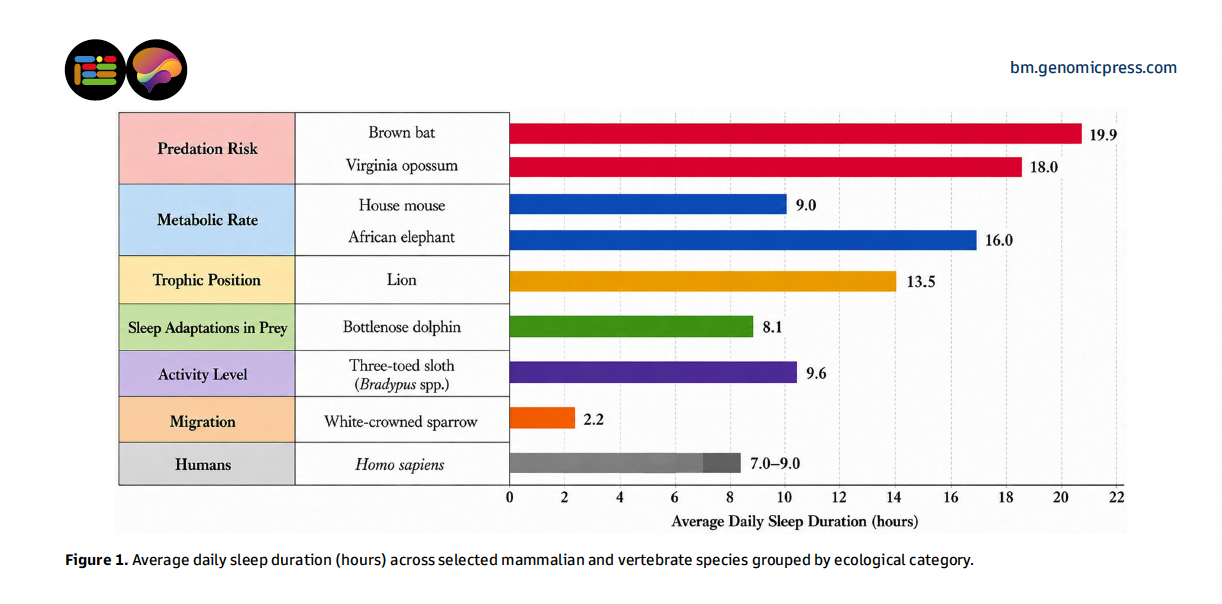
Ecology, rather than any universal optimum, writes the schedule. Across animals, sleep architecture varies with predation risk and metabolic rate. Prey species sleep lightly and in short frequent bouts, because sensory disconnection is expensive when something is hunting you. Lions, facing few threats and holding secure sleeping sites, sit at the opposite end. Cetaceans, pinnipeds, and several birds split the difference with unihemispheric slow-wave sleep, one hemisphere resting while the other keeps watch. There is a cautionary detail buried in the comparative data as well: field actigraphy (motion tracking worn on the body) in wild three-toed sloths records roughly nine to ten hours of sleep per day, against the fifteen to twenty hours long reported from captive animals. Where the measurement is taken changes the answer.
The urban ledger comes due when the review follows sleep out of the laboratory and into the street, where the evidence turns from evolutionary to political. Neighborhood socioeconomic disadvantage predicts reduced sleep efficiency and greater nighttime wakefulness even after individual factors are controlled, and it predicts shorter sleep in children. A housing upgrading program in Buenos Aires that moved residents from makeshift dwellings into prefabricated modular units produced measurable gains in subjective sleep quality. National spatial analyses in the United States document that nighttime light and traffic noise run substantially higher in low-income and racially segregated neighborhoods than in more affluent areas of the same cities. Approximately twenty percent of workers in industrialized countries do night shift work.
Climate change enters as an amplifier. Projections cited in the review indicate that, under a high-emissions scenario and assuming no further behavioral or technological adaptation, warming could add six to fourteen nights of insufficient sleep per one hundred individuals annually between 2050 and 2099 in the United States, falling hardest on lower-income people and on warmer regions.
“Sleep is not distributed the way people assume,” said Dr. Haitham Jahrami, co-author, of the Psychiatry Hospital, Government Hospitals, Manama, and the Department of Psychiatry at the College of Medicine and Medical Sciences, Arabian Gulf University, Bahrain. “Noise, light, heat, and housing quality fall hardest on the people least able to shield themselves, and every one of those exposures is tractable. Building codes and lighting standards are sleep interventions, even though nobody files them under that heading.”
There is a good deal the review cannot say, and the authors are explicit about it. This is a narrative review rather than a systematic synthesis, topic selection followed their judgment about which sources bridge macro-level and micro-level accounts, and many methodologically sound studies fell outside those bridging themes and were excluded. Readers wanting systematic coverage of sleep duration, sleep disorders, or circadian biology are pointed elsewhere. A cross-sectional finding of elevated oxidative stress biomarkers among segmented sleepers in Oman cannot establish causation and rests on a sample of mainly young adults. Large wearable-device studies capture only people who own consumer wearables, which leaves informal urban settlements in low- and middle-income countries largely invisible.
And one question sits open at the center of everything. If seven to eight hours of sleep confers health benefits, does it still confer them when the seven to eight hours arrive in two pieces? The literature on duration does not ask. The literature on regularity does not ask either. Nobody, as far as this synthesis can determine, has tested whether split sleep with reliable timing performs as well as consolidated sleep. For a species that may have slept in more than one shape for most of its history, that is a conspicuous silence.
“We have spent generations auditing how long people sleep and almost no time asking when,” said Dr. Randy J. Nelson, corresponding author, of the Department of Neuroscience at West Virginia University in Morgantown. “The clock, not the total, is what industrial life moved, and the clock is what we should be measuring.”
The immediate practical consequence is smaller and more useful than a headline number. Sleep assessment, the authors argue, should move beyond duration alone and routinely incorporate timing, regularity, and indices of circadian alignment, because those are the dimensions modern living actually disturbs. The eight-hour night may or may not be right for any given person. The review suggests we have simply been measuring the wrong thing.
The peer-reviewed review article in Brain Medicine titled “The new science of sleep: Insights from pre-industrial societies and phylogenomics,” is freely available via Open Access, starting on 25 August 2026 in Brain Medicine at the following hyperlink: https://doi.org/10.61373/bm026w.0060
The full reference for citation purposes is: Pandi-Perumal SR, Saravanan KM, Spence DW, Alsaif SS, Jahrami H, BaHammam AS, Shneerson JM, Nelson RJ. The new science of sleep: Insights from pre-industrial societies and phylogenomics. Brain Medicine 2026. DOI: https://doi.org/10.61373/bm026w.0060. Epub 2026 Aug 25.
About Brain Medicine: Brain Medicine (ISSN: 2997-2639, online and 2997-2647, print) is a peer-reviewed medical research journal published by Genomic Press, New York. Brain Medicine is a new home for the cross-disciplinary pathway from innovation in fundamental neuroscience to translational initiatives in brain medicine. The journal’s scope includes the underlying science, causes, outcomes, treatments, and societal impact of brain disorders, across all clinical disciplines and their interface.
Visit the Genomic Press Virtual Library: https://issues.genomicpress.com/bookcase/gtvov/
Our media website is at: https://media.genomicpress.com/
Our full website is at: https://genomicpress.com/
Ma-Li Wong
Genomic Press
mali.wong@genomicpress.com
Visit us on social media:
X
LinkedIn
Bluesky
Instagram
Facebook
Legal Disclaimer:
EIN Presswire provides this news content “as is” without warranty of any kind. We do not accept any responsibility or liability
for the accuracy, content, images, videos, licenses, completeness, legality, or reliability of the information contained in this
article. If you have any complaints or copyright issues related to this article, kindly contact the author above.

Media gallery