
How Vadzo Imaging’s Software Focus Control USB Camera Powers Iris Recognition: Falcon-900MGH Brings IMX900 NIR Global Shutter Precision to Border and Access Control Systems
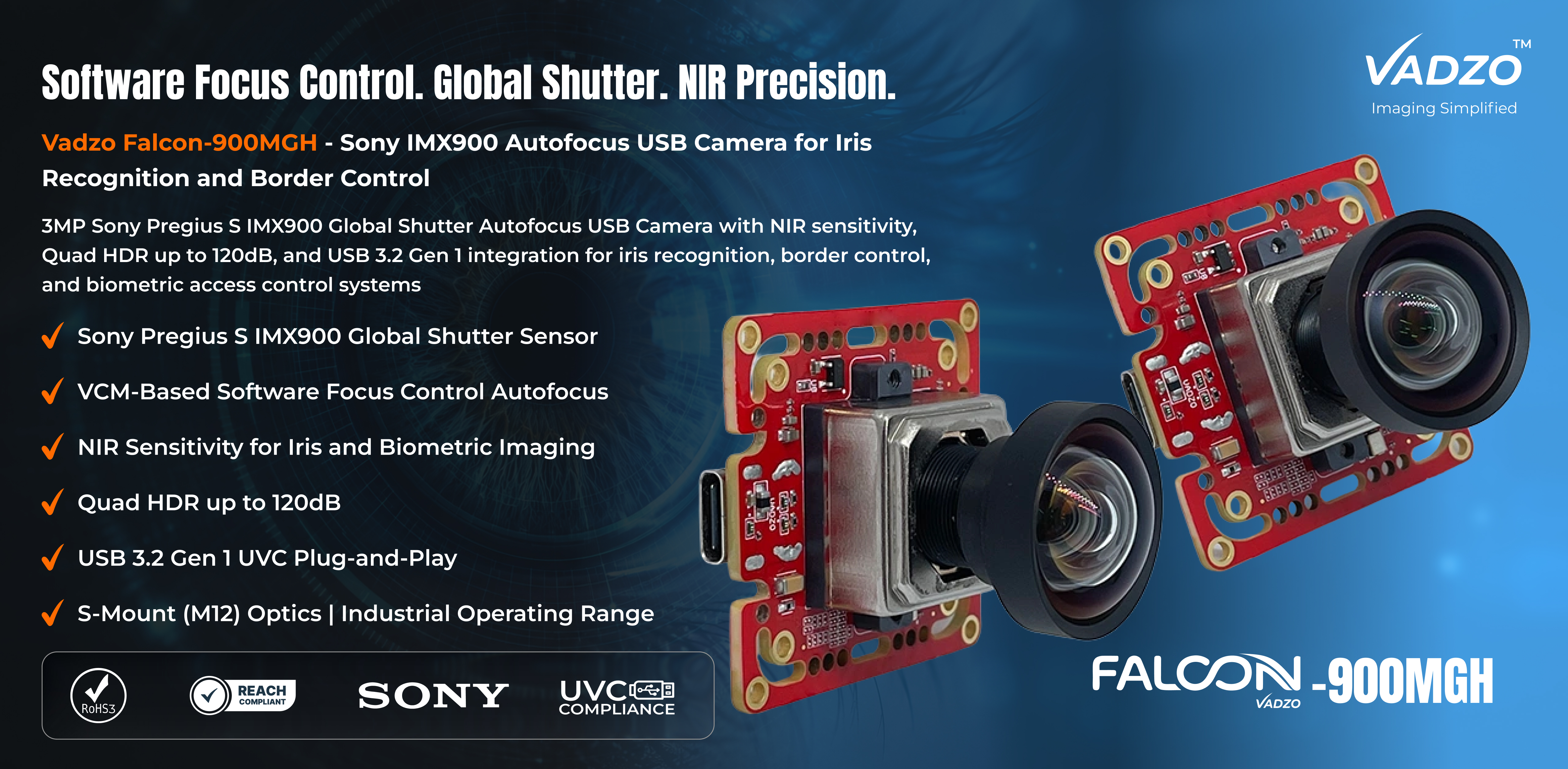
Vadzo Imaging's Falcon-900MGH is a 3MP Sony IMX900 Software Focus Control USB camera delivering monochrome global

Press Release Disclaimer: This is a press release distributed through the XPR Media network. It has not been independently verified by our newsroom.


Vadzo Imaging’s Falcon-900MGH is a 3MP Sony IMX900 Software Focus Control USB camera delivering monochrome global shutter imaging with 2.25 µm BSI pixels, NIR sensitivity, Quad HDR up to 120dB, and USB 3.2 Gen 1 UVC integration for iris recognition, border control, and biometric access control platforms where focus consistency across variable subject distances and motion-artifact-free capture are simultaneous design requirements.
FORT WORTH, TX / ACCESS Newswire / August 4, 2026 / Vadzo Imaging, a provider of embedded vision camera products, today announces the launch of the Falcon-900MGH, a Software Focus Control USB camera built on the Sony Pregius S IMX900 sensor for OEM teams building iris recognition, border control, and biometric access control systems requiring dynamic focus adjustment across variable subject distances. As an IMX900 Global Shutter Autofocus USB Camera delivering 3MP (2064×1552) monochrome output with NIR sensitivity and 2.25 µm BSI pixels, the Falcon-900MGH connects to host systems over USB 3.2 Gen 1 without custom driver development or fixed-focus optical calibration.
Sensor and Camera Overview
The Falcon-900MGH is built on the Sony Pregius S IMX900, a 1/3.1″ stacked CMOS global shutter sensor with a 2.25 µm x 2.25 µm pixel pitch and a native resolution of 3MP (2064×1552). As a Sony Pregius IMX900 Camera and IMX900 Image Sensor platform, it uses a monochrome architecture that removes the Bayer color filter mosaic, maximizing photon capture per pixel and delivering the NIR sensitivity that biometric capture at 850 nm and 940 nm depends on. The Sony IMX900 Global Shutter Sensor combines a back-illuminated stacked design with global shutter readout, ensuring every pixel in the frame is captured simultaneously and eliminating the rolling shutter distortion that disqualifies front-illuminated sensors from iris recognition, facial recognition, and other motion-sensitive biometric capture pipelines.
Unlike fixed-focus IMX900 Monochrome USB Camera variants in Vadzo’s Falcon lineup, the Falcon-900MGH adds software-controlled focus through an integrated VCM mechanism, making it a true Software Focus Control USB camera rather than a single-working-distance module. As subjects approach an iris scanner, a border control checkpoint, or an access control terminal at inconsistent distances, the IMX900 Autofocus USB Camera adjusts focus dynamically without operator intervention or lens replacement. This differs from a Liquid Lens Autofocus Camera, which achieves variable focus by deforming an optical fluid membrane under applied voltage rather than moving a rigid lens element. Vadzo selected VCM Autofocus Camera architecture for the Falcon-900MGH because voice coil designs hold calibration more consistently across the industrial temperature range and vibration profile that border and access control installations experience.
As a Global Shutter Autofocus USB Camera, the Falcon-900MGH connects via USB 3.2 Gen 1 with full UVC compliance, supporting full 3MP output as well as windowed region-of-interest streaming for eye or iris-only capture. The camera accepts standard S-Mount (M12) optics, operates across an industrial temperature range, and integrates with Windows and Linux hosts without custom driver development.
Key specs: Sony Pregius S IMX900 | 3MP (2064×1552) | Global Shutter | Sensor Format 1/3.1″ | Pixel Size 2.25 µm x 2.25 µm | NIR Sensitivity | VCM Autofocus (Software Focus Control) | USB 3.2 Gen 1 | S-Mount (M12) | Quad HDR (up to 120dB)
Key Capabilities of the Falcon-900MGH: IMX900 Global Shutter Autofocus USB Camera
Software Focus Control via VCM Autofocus for Variable Working-Distance Biometric Capture: The defining capability of the Falcon-900MGH is software-controlled focus. As a Software Focus Control USB camera, it uses a Voice Coil Motor to move the lens element along the optical axis in response to host commands, rather than requiring a technician to set a single fixed focus distance at installation. This matters directly for iris recognition and border control applications, where a traveler, badge holder, or enrollment subject rarely stands at the exact same distance from the lens every time. A fixed-focus camera calibrated for one working distance produces soft captures the moment a subject deviates from it, directly degrading iris matching confidence and facial recognition template quality.
As an IMX900 Monochrome Autofocus USB Camera, the Falcon-900MGH resolves this by adjusting focus continuously within its designed working-distance range, whether driven by an onboard contrast-detection algorithm or direct software commands via the VISPA ARC SDK. Compared to a Liquid Lens Autofocus Camera, which relies on an optical fluid membrane, the VCM Autofocus Camera mechanism in the Falcon-900MGH offers more predictable, repeatable focus positioning across a wide operating temperature range, without the settling-time drift that fluid-lens elements can exhibit at extremes.
Global Shutter Precision for Motion-Free Iris and Facial Capture: Rolling shutter sensors read out pixel rows sequentially, and even slight subject motion during that readout window, a head turn, a blink, a slight sway, introduces geometric skew into the captured frame. For an Iris Recognition Camera or Biometric Iris Camera, that skew is not cosmetic: iris recognition algorithms depend on precise boundary geometry to normalize the pattern before matching, so motion-induced distortion reduces match confidence or forces a re-capture.
The Falcon-900MGH captures all 3MP pixels simultaneously as a Global Shutter Autofocus USB Camera, eliminating this failure mode at the point of capture rather than correcting for it afterward in software. This makes it suitable as a Retina Scanner Camera and Eye Recognition Camera platform where the subject is not physically restrained during capture, as is typical in walkthrough border control lanes and self-service access control kiosks. The same IMX900 Global Shutter USB Camera integrity benefits facial recognition at access gates, where subjects are walking and a rolling-shutter sensor would introduce motion blur at typical walking speeds.
NIR Sensitivity and Monochrome Architecture for Active Illumination Imaging: Iris recognition, in particular, depends on near-infrared illumination rather than visible light. Iris texture that appears nearly featureless under visible light reveals significantly more detail under 850 nm or 940 nm NIR illumination, and NIR capture avoids the pupil constriction and subject discomfort associated with visible-spectrum flash. A color sensor’s Bayer filter mosaic absorbs a substantial fraction of incident light, including most NIR-wavelength photons, while separating red, green, and blue channels. The Falcon-900MGH, as an IMX900 Monochrome Autofocus USB Camera, has no filter layer, so the full photon flux at every pixel reaches the photodiode across both the visible and NIR spectrum.
This makes the Falcon-900MGH function as an NIR Biometric Camera and NIR Sensitive Camera with meaningfully higher signal-to-noise ratio at biometric illumination wavelengths than a color sensor of equivalent pixel pitch. As an IMX900 NIR Camera and IMX900 NIR Monochrome Camera, it is positioned for iris recognition, vein pattern imaging, and face liveness detection under active NIR illumination, where illuminator and sensor are matched to operate outside the visible spectrum. The 3MP NIR Monochrome Camera architecture of the Falcon-900MGH removes the primary sensitivity bottleneck that color sensors introduce.
Quad HDR for Mixed Ambient and NIR Illumination Environments: Border checkpoints, airport queues, and outdoor access control terminals rarely offer controlled, uniform lighting, with subjects lit by sunlight, overhead fluorescents, and the NIR illuminator simultaneously. The IMX900 sensor’s Quad HDR mode, supporting up to 120dB of dynamic range, allows the Falcon-900MGH to hold detail in both the brightly NIR-illuminated iris region and the comparatively dark surrounding facial area within the same frame, rather than clipping one region to preserve the other.
For OEM developers integrating the Falcon-900MGH into an enclosure with an active NIR illuminator, Quad HDR reduces the tuning burden significantly, since the ISP needs no per-installation exposure calibration to offset illuminator brightness against ambient light. This is a direct advantage for a Biometric Access Control Camera or Access Control USB Camera deployed across sites with different ambient lighting, since the same exposure configuration performs consistently indoors, outdoors, and under mixed lighting without site-specific recalibration.
GPIO Trigger Synchronization and UVC Plug-and-Play Integration: The Falcon-900MGH includes GPIO support for hardware-level trigger and strobe synchronization, firing in coordination with an external NIR illuminator or a proximity sensor when a subject enters the capture zone. This is particularly relevant for Border Control Camera and Access Control USB Camera installations, where continuous streaming would waste illuminator lamp life and triggered capture produces a cleaner set of frames for the matching engine to evaluate.
Product Specifications
The following specifications summarize the Falcon-900MGH IMX900 Global Shutter Autofocus USB Camera platform:
|
Specification
|
Detail
|
|
Sensor
|
Sony Pregius S IMX900
|
|
Sensor Architecture
|
Monochrome, back-illuminated, stacked CMOS
|
|
Resolution
|
3MP (2064 × 1552)
|
|
Shutter Type
|
Global Shutter
|
|
Pixel Size
|
2.25 µm x 2.25 µm
|
|
Sensor Format
|
1/3.1″
|
|
HDR
|
Quad HDR, up to 120dB
|
|
NIR Sensitivity
|
Yes, optimized for 850nm / 940nm active illumination
|
|
Autofocus
|
VCM (Voice Coil Motor) based Software Focus Control
|
|
Lens Mount
|
S-Mount (M12)
|
|
Interface
|
USB 3.2 Gen 1, UVC compliant
|
|
GPIO
|
Hardware trigger and strobe synchronization
|
|
SDK
|
Vadzo VISPA ARC SDK (C, C++, C#, Python)
|
|
Platform Compatibility
|
Windows and Linux, plug-and-play UVC, no custom driver required
|
|
Form Factor
|
38mm x 38mm, convertible to 32mm x 32mm
|
|
Compliance
|
UVC, RoHS 3, REACH
|
“Iris recognition and border control systems live or die on focus consistency and NIR sensitivity, and most fixed-focus camera products simply were not built for either. The Falcon-900MGH pairs the IMX900’s global shutter and NIR performance with genuine software focus control, so the camera keeps up with subjects at inconsistent distances instead of forcing every installation into a single calibrated working distance. That is the specific gap this camera fills for OEM teams building biometric access control and border security systems.” – Alwin Vincent, Product Manager at Vadzo Imaging.
Target Applications
Iris Recognition and Biometric Enrollment Systems: Iris recognition systems capture the unique texture pattern of the iris under NIR illumination and compare it against an enrolled template for identity verification. The process depends on a sharply focused, motion-free, high-contrast capture of the iris boundary, directly served by the Falcon-900MGH’s combination of VCM software focus control, global shutter readout, and monochrome NIR sensitivity. As a Biometric Iris Camera and Iris Scanning Camera, the Falcon-900MGH accommodates the natural variation in eye height and standing distance across a population of enrollees, rather than requiring each subject to align precisely with a single fixed focus plane.
This matters for large-scale enrollment programs, including national ID systems and visa processing centers, where enrollment stations cannot afford to re-capture a meaningful fraction of subjects due to focus or motion errors. As an Iris Recognition Camera built for exactly this throughput requirement, the Falcon-900MGH reduces the re-capture rate that a fixed-focus or rolling-shutter sensor would otherwise introduce into an enrollment workflow.
Border Control and Immigration Checkpoints: Automated border control gates and immigration checkpoints increasingly rely on iris and facial biometric verification to process travelers without a staffed inspection at every lane. Subject height, gait, and stopping position at the capture unit vary meaningfully from one traveler to the next, and the checkpoint cannot pause processing to manually adjust camera focus between subjects. The Falcon-900MGH, as a Border Control Camera and border security platform, addresses this directly through VCM-based software focus control that adjusts automatically as each traveler approaches, combined with Quad HDR to handle the mixed ambient and NIR-illuminated lighting typical of checkpoint lanes.
For OEM integrators building automated border control kiosks, the Falcon-900MGH’s 3MP Global Shutter USB Camera architecture and USB 3.2 Gen 1 UVC interface simplify integration with the embedded compute platforms already running facial and iris matching software at these checkpoints, without custom driver development specific to the deployment.
Access Control and Secure Facility Entry: Secure facility entry systems, including data center access points and government facility checkpoints, use biometric access control to verify identity before granting physical entry. The Falcon-900MGH functions as a Biometric Access Control Camera and Access Control USB Camera in these deployments, using NIR-illuminated iris or facial capture combined with software focus control to accommodate the range of approach distances and heights across an employee or visitor population.
GPIO-triggered capture, synchronized with a door proximity sensor or badge reader, activates biometric capture only when a subject is present, reducing both matching-engine load and NIR illuminator duty cycle. As an Eye Recognition Camera and Retina Scanner Camera platform, the Falcon-900MGH also serves higher-security access control tiers where iris or retinal verification supplements or replaces badge-based entry.
Facial Recognition Terminals and Kiosk-Based Identity Verification: Self-service kiosks that perform facial recognition for identity verification, whether at a transit gate, a financial services terminal, or a visitor management station, encounter subjects at inconsistent standing distances and under kiosk-integrated lighting that differs from ambient lighting. The Falcon-900MGH operates as a Facial Recognition USB Camera in these deployments, using software focus control to maintain sharp facial capture across the kiosk’s expected interaction range without requiring precise alignment to a marked floor position.
The camera’s compact board footprint and USB-powered architecture simplify integration into kiosk enclosures with constrained space and power budgets, while UVC plug-and-play compliance allows integration across Windows and Linux kiosk platforms without dedicated driver development.
Law Enforcement and Public Security Vision Systems: Law enforcement and public security applications, including watchlist screening at transit hubs and mobile biometric verification units, require a Border Security Vision Camera capable of consistent NIR-illuminated capture across varied field conditions and subject distances. The Falcon-900MGH’s Quad HDR handles the transition between outdoor ambient light and NIR illumination typical of these deployments, while its industrial operating range supports vehicle-mounted units and semi-outdoor checkpoint structures.
As an NIR Biometric Camera suited to both fixed installations and mobile units, the Falcon-900MGH gives system integrators a single hardware platform covering iris capture, facial recognition, and general NIR-illuminated identity verification, reducing the number of distinct camera modules an integrator needs to qualify and support.
Platform and SDK Support
The Falcon-900MGH is supported by the Vadzo VISPA ARC SDK, providing programmatic control over VCM autofocus behavior, region-of-interest configuration, exposure, GPIO trigger and strobe synchronization, and Quad HDR mode selection. APIs are available in C, C++, C#, and Python across Windows and Linux, letting OEM teams integrate advanced camera control into biometric matching applications without disrupting the plug-and-play IMX900 USB Camera streaming behavior used for standard capture.
For OEM teams building border control or access control kiosks, the SDK’s autofocus control API lets the host application drive focus explicitly rather than relying on the onboard contrast-detection algorithm, useful when enclosure geometry is known in advance. Full SDK documentation and CAD files for the Falcon-900MGH IMX900 Monochrome USB Camera platform are available directly from Vadzo Imaging, alongside engineering support for OEM programs moving into volume production.
Frequently Asked Questions
Q: How does global shutter improve iris recognition accuracy in border control and access control systems?
A: Rolling shutter sensors read pixel rows sequentially, so even slight subject motion during capture, a head shift, a blink, a step forward, produces geometric distortion in the iris or facial boundary, directly reducing match confidence and increasing re-capture rates. Global shutter sensors expose every pixel simultaneously, eliminating this failure mode at capture. Vadzo Imaging’s Falcon-900MGH uses the Sony Pregius S IMX900 global shutter sensor for this reason, delivering geometrically accurate capture for iris recognition, facial recognition, and biometric access control deployments where subjects are not physically restrained during capture.
Q: What NIR wavelength should an iris recognition camera support for accurate biometric capture?
A: Most iris recognition systems illuminate the subject at 850 nm or 940 nm near-infrared wavelengths, which reveal iris texture largely invisible under visible light while remaining unobtrusive to the subject. The camera’s sensor needs monochrome, filter-free architecture to capture this NIR signal efficiently, since a Bayer color filter mosaic absorbs a significant portion of NIR-wavelength photons in the process of separating color channels. A monochrome global shutter sensor with strong quantum efficiency at these wavelengths, rather than a color sensor of equivalent pixel pitch, is the correct architecture choice for reliable iris texture capture.
Q: Why does a monochrome sensor outperform a color sensor for NIR biometric imaging?
A: A color sensor separates light into red, green, and blue channels using a Bayer filter mosaic, and that filter layer absorbs a substantial fraction of incident photons, including most near-infrared light, to perform the separation. A monochrome sensor has no filter layer, so every pixel routes its full photon flux directly to the photodiode across both the visible and NIR spectrum. This produces a materially higher signal-to-noise ratio under NIR illumination at equivalent pixel pitch, which is why NIR-illuminated biometric systems, including iris scanners and vein pattern imagers, consistently specify monochrome sensors rather than color variants.
Q: What is the difference between VCM autofocus and liquid lens autofocus in an embedded USB camera?
A: VCM (Voice Coil Motor) autofocus moves a rigid lens element along the optical axis using a small electromagnetic coil adjusting focus position in milliseconds with high repeatability across a wide temperature range. Liquid lens autofocus instead changes the curvature of an optical fluid membrane by applying voltage across it, achieving variable focus without a moving mechanical element, though fluid-based elements can exhibit longer settling time and greater focus drift at temperature extremes than a voice coil design. Vadzo Imaging selected VCM autofocus for the Falcon-900MGH specifically because border and access control installations run continuously across wide temperature swings, where focus repeatability matters more than the marginal size advantage liquid lens offers.
Q: Which USB camera interface is best suited for iris scanning and access control kiosk integration?
A: An iris scanning or access control kiosk camera needs a USB interface with UVC compliance for driverless operation across Windows and Linux, along with sufficient bandwidth to stream full-resolution monochrome NIR frames at the required frame rate. USB 3.2 Gen 1 provides this bandwidth headroom for a 3MP sensor while remaining widely supported across the embedded compute platforms and industrial PCs typically used in kiosk and checkpoint deployments. Vadzo Imaging’s Falcon-900MGH ships as a USB 3.2 Gen 1 UVC-compliant module for exactly this reason, giving kiosk and checkpoint integrators plug-and-play compatibility alongside the VISPA ARC SDK for deeper camera control when an application requires it.
Availability and Customization
The Falcon-900MGH Sony Pregius S IMX900 Global Shutter Autofocus USB Camera is available now for evaluation and OEM integration. Vadzo Imaging supports full OEM customization across the Falcon-900MGH platform, including board-level redesign, firmware development, custom GPIO and strobe timing for NIR illuminator designs, lens and optical filter modification for NIR bandpass filtering, and enclosure design for kiosk, checkpoint, and outdoor installations. Evaluation units are available with no minimum order requirement, and volume customization is available through Vadzo’s OEM camera engineering team.
OEM teams evaluating a 3MP Autofocus USB Camera for iris recognition or border control integration can request full specifications, an evaluation unit, or engineering support directly from the Vadzo Imaging sales team.
About Vadzo Imaging
Vadzo Imaging develops embedded and machine vision camera products for OEMs and system integrators building production-ready vision systems across industrial automation, robotics, healthcare, biometric security, and smart infrastructure. The company’s camera portfolio spans MIPI CSI-2, USB, Gigabit Ethernet, Wi-Fi, and SerDes interfaces, supporting a wide range of embedded deployment architectures. Vadzo provides end-to-end imaging support including sensor integration, ISP tuning, firmware development, and SDK frameworks to accelerate system deployment. Learn more at www.vadzoimaging.com.
Media Contact
Alwin Vincent
Vadzo Imaging
Email: alwin@vadzoimaging.com
LinkedIn: Vadzo Imaging
YouTube: Vadzo Imaging
X: Vadzo Imaging
SOURCE: Vadzo Imaging
View the original press release on ACCESS Newswire
Media gallery

