Centrifugal Blower Market to Reach USD 7.99 Billion by 2035 at 5.2% CAGR
The global Centrifugal Blower Market reached an estimated USD 4.82 billion in 2025 and is projected to grow from USD

Press Release Disclaimer: This is a press release distributed through the XPR Media network. It has not been independently verified by our newsroom.
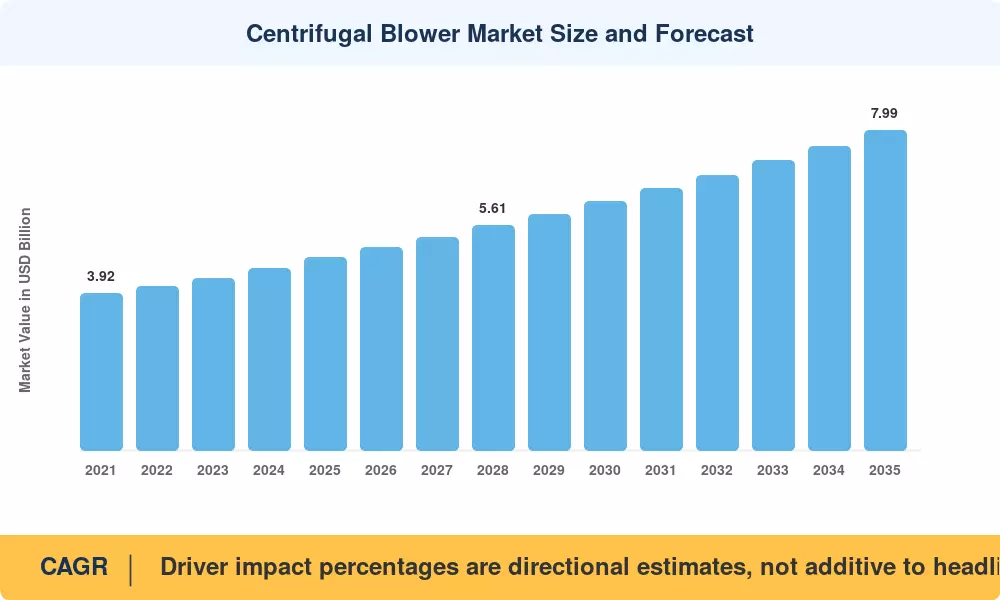

The global Centrifugal Blower Market reached an estimated USD 4.82 billion in 2025 and is projected to grow from USD 5.07 billion in 2026
NEW YORK, NY, UNITED STATES, July 27, 2026 /EINPresswire.com/ — The global Centrifugal Blower Market reached an estimated USD 4.82 billion in 2025 and is projected to grow from USD 5.07 billion in 2026 to USD 7.99 billion by 2035, registering a CAGR of 5.2% during the forecast period (2026–2035).
Market Overview
Centrifugal blowers are critical industrial machines that use high-speed rotating impellers to move air, gases, or particulate-laden streams across a wide range of industrial processes . These devices convert kinetic energy from a rotating impeller into pressure energy, creating a steady, high-volume airflow essential for applications such as combustion air supply, material conveying, ventilation, and aeration . Available in designs including backward curved, radial blade, forward curved, and airfoil configurations, centrifugal blowers are selected based on specific pressure, flow, and efficiency requirements across diverse industries .
The market’s steady growth is driven by several powerful catalysts. Two structural tailwinds anchor this trajectory: tightening industrial emissions mandates under the EU Industrial Emissions Directive and accelerating brownfield modernization across cement, steel, and power plants in developing Asia . Capital expenditure on air handling and gas conveyance infrastructure topped USD 11 billion globally in 2024, with centrifugal blower replacements capturing a growing share of that spending . The power generation sector remains the top demand vertical, contributing roughly 24% of global revenues .
Industry trends indicate a decisive shift from legacy constant-speed blower installations to digitally controlled, variable-speed systems that cut energy consumption by 20–35% . The U.S. Department of Energy’s Industrial Decarbonization Roadmap targets a 30% reduction in industrial compressed-air and blower energy use by 2030, directly incentivizing upgrades . European manufacturers are similarly aligning product portfolios around IE5 ultra-premium-efficiency motors, pushing lifecycle cost arguments over upfront price .
Technological developments are reshaping the centrifugal blower landscape. Integration of IoT-enabled sensors, vibration monitoring, and temperature sensors is enabling condition-based maintenance models that reduce unplanned downtime by 30–50% . The development of digital twins and AI-driven performance optimization systems that autonomously adjust impeller speed, inlet-vane angles, and maintenance schedules represents the next frontier . OEMs investing in edge-computing integration are capturing premium pricing and differentiating against commoditized competitors .
Policy and regulatory influence on the market is substantial. The EU’s Fit for 55 package requires plant operators to replace oversized, throttle-controlled blowers with right-sized, variable-speed machines to achieve a 55% reduction in industrial greenhouse-gas emissions by 2030 compared to 1990 levels . In the United States, the Inflation Reduction Act provides a 30% investment tax credit for compressed-air and blower systems, allotting USD 6 billion for industrial energy efficiency . The EU Ecodesign Regulation mandates minimum energy efficiency indices for all fan units above 125 W placed on the EU market from 2025 .
The demand outlook remains positive, supported by industrial decarbonization mandates, wastewater infrastructure expansion, and energy-efficiency retrofit cycles. Asia-Pacific commands the largest regional share at approximately 38% of global revenue, driven by China’s cement and wastewater treatment build-out . North America holds roughly 27% share, buoyed by shale-gas processing and EPA emission compliance upgrades, while Europe accounts for about 22%, anchored by circular-economy retrofits . The market is poised for sustained expansion as decarbonization policies and industrial digitalization converge across every major end-use vertical .
📍 Get Free Sample Report for Detailed Market Insights:
https://www.marketresearchfuture.com/sample_request/27071
Market Segmentation
By Type
The centrifugal blower market is segmented by type into Backward Curved, Radial Blade, Forward Curved, and Airfoil designs . Backward curved blowers dominate the market with an estimated 34% revenue share, favored for high-efficiency HVAC and process-air applications due to their non-overloading power characteristic and high peak efficiency (up to 87%) . Wastewater treatment plants overwhelmingly specify backward curved units for aeration duty . Radial blade designs register the fastest segment CAGR at 6.1%, driven by heavy-duty material handling in mining, cement dust collection, and pneumatic conveying where particulate loading and abrasion resistance are critical . Forward curved blowers account for approximately USD 0.77 billion in 2025, serving low-pressure ventilation and residential HVAC applications . Airfoil blowers represent approximately USD 0.91 billion in 2025, serving clean-air applications across pharmaceutical, electronics manufacturing, and semiconductor cleanrooms .
By End-Use Industry
End-use segmentation covers Power Generation, Chemical & Petrochemical, Water & Wastewater, Cement & Mining, and Others (Pharma, Food, Pulp) . Power generation remains the top demand vertical, contributing roughly 24% of global revenues, driven by primary-air and secondary-air fan requirements in coal and gas-fired plants, plus induced-draft fans for flue-gas desulfurization . Chemical and petrochemical plants represent USD 0.84 billion in 2025 blower consumption for process-gas handling and vapor recovery . Water and wastewater treatment is the fastest-growing segment at approximately 6.4% CAGR through 2035, fueled by municipal infrastructure investment across India and Southeast Asia . Aeration blowers account for 50–60% of a wastewater plant’s total energy consumption, making them a high-value procurement line item . Cement and mining represent 18% of market share, driven by kiln air, dust collection, and material conveying requirements .
By Pressure Range
Pressure range segmentation includes Low Pressure ( 2,500 mmWG) . Low-pressure centrifugal blowers dominate by volume with 42% share, with HVAC and general building ventilation accounting for the broadest installed base . Medium-pressure blowers represent approximately USD 1.68 billion in 2025, serving aeration and process air applications . The high-pressure end is expanding fastest at a CAGR of 5.8%, as gas-boosting applications in hydrogen, biogas, and carbon-capture plants scale up through the forecast period .
By Region
Regional segmentation includes North America, Europe, Asia Pacific, South America, and the Middle East and Africa . Asia-Pacific leads at 38% share, with China alone accounting for over half of regional demand . North America holds roughly 27% share, delivering steady growth at 4.6% CAGR supported by refinery modernization and data-center cooling . Europe accounts for about 22% with a CAGR of 4.8%, anchored by circular-economy retrofits . The Middle East & Africa is the fastest-growing region outside Asia-Pacific at 5.9% CAGR, linked to desalination and petrochemical megaprojects . South America represents a smaller market valued at USD 0.34 billion in 2025 .
🛒 You can buy this market report at:
https://www.marketresearchfuture.com/checkout?currency=one_user-USD&report_id=27071
Regional Analysis
North America
North America holds roughly 27% of the global centrifugal blower market share, with the United States dominating at 78% of regional demand . The region’s market is anchored by refinery fluid catalytic cracking air requirements, shale-gas processing, and a growing cohort of hyperscale data centers along the Virginia–Ohio corridor . The Inflation Reduction Act’s industrial efficiency incentives have shortened capital payback cycles for blower replacements, while EPA Quad Oa methane regulations are pushing upstream oil and gas operators toward low-emission blower solutions . Canada contributes steadily at 4.3% CAGR, driven by oil sands processing, pulp and paper operations, and mining activities . Mexico represents a growing market at USD 0.07 billion, supported by cement and automotive manufacturing expansion .
Europe
Europe accounts for approximately 22% of the global market, with demand shaped by the continent’s aggressive decarbonization timeline. Germany leads regional demand at 28% of European share, driven by chemical and automotive plant upgrades . The UK follows at 5.0% CAGR, supported by its Net Zero industrial strategy . France contributes USD 0.14 billion, driven by nuclear auxiliary systems and wastewater treatment . High energy prices across the continent have made lifecycle-cost arguments more persuasive than ever for centrifugal blower procurement committees . Nordic process industries and Eastern EU accession upgrades represent additional growth pockets .
Asia-Pacific
Asia-Pacific commands the largest share at approximately 38% of global revenue and leads growth with a forecast CAGR of 6.8% . China dominates at 52% of regional share, with its cement sector alone operating over 1,700 rotary kilns, each requiring multiple centrifugal blowers for combustion air, clinker cooling, and emissions control . India is the fastest-growing major market at 7.4% CAGR, fueled by the AMRUT 2.0 wastewater build-out targeting 100% urban sewage treatment by 2030 . Japan contributes USD 0.19 billion through process-industry retrofits and semiconductor fabrication facilities . South Korea grows at 5.1% CAGR, driven by battery and petrochemical plant expansion . Southeast Asian urbanization supports the remaining 12% of regional share .
Rest of the World
The Rest of the World segment, encompassing South America, the Middle East, and Africa, presents developing market opportunities. The Middle East & Africa region is the fastest-growing outside Asia-Pacific at 5.9% CAGR, linked to Saudi Vision 2030 industrialization, UAE desalination capacity expansion targeting 1.8 billion imperial gallons per day by 2030, and petrochemical megaprojects across the Gulf Cooperation Council states . South America is valued at USD 0.34 billion in 2025, with Brazil accounting for 58% of regional share driven by mining, ethanol processing, and pulp and paper . Chile’s copper pipeline—projected to require USD 65 billion in investment through 2032—creates steady demand for dust-collection and conveying blower systems .
Competitive Landscape / Key Players
The global centrifugal blower market is moderately fragmented, with the top five players collectively holding approximately 30–35% of global revenue . Key companies operating in this market include Howden (Chart Industries), Ingersoll Rand (Gardner Denver), Continental Blower LLC, Twin City Fan & Blower, New York Blower Company, Halifax Fan Ltd, Hartzell Air Movement, Chicago Blower Corporation, Clarage, and Aerovent .
Strategic developments in the market include significant product launches and acquisitions. In March 2025, Howden launched a digitally integrated centrifugal fan platform with embedded IoT sensors for real-time performance monitoring, targeting wastewater and mining verticals . In November 2024, Ingersoll Rand completed the acquisition of a European specialty blower manufacturer, expanding its medium-pressure centrifugal product line for chemical process applications . Twin City Fan & Blower introduced a backward curved plenum fan series rated to IE5 motor compatibility in August 2024, reducing system energy consumption by up to 28% versus prior-generation models .
Competitive differentiation centers on aerodynamic efficiency, noise performance, digital service capabilities, and aftermarket network density . Global diversified industrials compete alongside regional specialists and engineering-to-order fabricators, with differentiation increasingly dependent on IoT capabilities and lifecycle service offerings . The installed base of centrifugal blowers globally exceeds 2.5 million units, creating a substantial aftermarket opportunity .
Latest Industry News & Developments
Recent industry developments highlight the ongoing transformation of the centrifugal blower market toward digitalization and sustainability. The U.S. Department of Energy published updated test procedures for commercial and industrial fans and blowers under 10 CFR 431 in June 2024, establishing stricter minimum efficiency standards effective January 2027 . This regulatory development is accelerating replacement cycles across industrial facilities.
In February 2024, New York Blower Company opened a regional service center in Houston, Texas, to support Gulf Coast refinery and petrochemical clients with rapid blower overhaul and parts supply . The EU Commission finalized Ecodesign Regulation (EU) 2023/xxx for industrial fans in September 2023, mandating minimum energy efficiency indices for all fan units above 125 W placed on the EU market from 2025 . Halifax Fan commissioned a new high-temperature centrifugal fan test facility in the UK capable of validating units operating at up to 1,000°C for steel and glass industry applications in May 2023 .
Market Challenges & Opportunities
Key restraints facing the centrifugal blower market include raw material and steel price volatility, with material costs typically representing 35–45% of total manufacturing cost . Hot-rolled coil steel prices swung between USD 550 and USD 1,100 per metric ton during 2022–2024, squeezing OEM margins . Competition from alternative blower technologies, particularly high-speed turbo blowers with magnetic-bearing technology, has grown at 12% annually in wastewater aeration applications . Skilled labor shortages—the U.S. Bureau of Labor Statistics projects a 14% shortfall in industrial machinery mechanics by 2030—extend project timelines and raise total cost of ownership . Extended capex approval cycles in heavy industry and noise and vibration regulatory constraints further limit growth .
Emerging opportunities in the market are substantial and diverse. IoT-enabled predictive maintenance platforms represent a high-margin growth opportunity, with OEMs that bundle digital monitoring subscriptions capturing recurring revenue streams worth an estimated 8–12% of initial equipment value annually . Emerging-market municipal infrastructure build-out, with the World Bank committing USD 38 billion to water and sanitation projects across low-income countries during 2022–2025, creates significant demand . The hydrogen economy and green fuel applications present a new vertical—by 2030, more than 40 GW of electrolyzer capacity will be operational, with each gigawatt-scale hydrogen hub requiring dozens of centrifugal blower units .
Future potential lies in noise-optimized designs for urban industrial zones as the EU Environmental Noise Directive revision targets 2028 implementation . Aftermarket parts and service monetization represents a USD 1.4 billion opportunity . Digital twins and autonomous blower operations, with plant-level digital-twin deployments expected to reach 65% penetration among Tier-1 industrial facilities by 2030, will enable AI-driven performance optimization . The transition from IE3 to IE5 motor standards across the EU and forthcoming U.S. DOE rulemaking on industrial motor efficiency will accelerate blower system replacements . Green hydrogen and carbon-capture integration could add USD 0.6–0.9 billion to the market by the end of the forecast period .
To explore more market insights, visit us at:
https://www.marketresearchfuture.com/reports/centrifugal-blower-market-27071
Final Market Summary
The centrifugal blower market is positioned for steady growth through 2035, driven by industrial decarbonization mandates, wastewater infrastructure expansion, and energy-efficiency retrofit cycles. The projected valuation of USD 7.99 billion reflects sustained demand across power generation, chemical processing, water treatment, and cement and mining sectors, with the market transitioning from legacy constant-speed systems to digitally controlled, variable-speed, and IoT-enabled solutions.
The medium-term growth outlook remains positive, supported by regulatory drivers including the EU’s Fit for 55 package, the U.S. Inflation Reduction Act, and updated efficiency standards from the Department of Energy. Asia-Pacific will continue to lead market expansion through China’s cement modernization and India’s wastewater infrastructure build-out, while North America and Europe maintain significant positions through technology leadership and regulatory-driven replacement cycles.
Long-term industry potential extends beyond the current forecast horizon, as the convergence of decarbonization imperatives, digital transformation, and the hydrogen economy reshapes the market landscape. The hydrogen and green fuel applications vertical, with over 40 GW of electrolyzer capacity expected by 2030, introduces new demand for specialized blower systems. The transition to IE5 ultra-premium-efficiency motors and the development of digital twin capabilities will continue to transform blower procurement and operation. Manufacturers that successfully develop energy-efficient, digitally integrated solutions, invest in IoT-enabled predictive maintenance platforms, and establish regional service networks in emerging markets will capture substantial value in this evolving market. Those that embrace innovation, expand aftermarket services, and address sustainability imperatives will lead the way in the centrifugal blower market of the future.
More Related Reports from MRFR Library:
Metal Cutting Tools Market: https://www.marketresearchfuture.com/reports/metal-cutting-tools-market-8159
Casino Gaming Equipment Market: https://www.marketresearchfuture.com/reports/casino-gaming-equipment-market-8194
Aluminum Die Casting Machine Market: https://www.marketresearchfuture.com/reports/aluminum-die-casting-machine-market-8250
Induction Furnace Market: https://www.marketresearchfuture.com/reports/induction-furnace-market-8251
Cnc Router Market: https://www.marketresearchfuture.com/reports/cnc-router-market-8321
Industrial Noise Control Market: https://www.marketresearchfuture.com/reports/industrial-noise-control-market-8459
Powder Processing Equipment Market: https://www.marketresearchfuture.com/reports/powder-processing-equipment-market-9576
Ball Bearing Market: https://www.marketresearchfuture.com/reports/ball-bearing-market-10084
Cnc Machine Market: https://www.marketresearchfuture.com/reports/cnc-machine-market-10107
Hydraulic Cylinders Market: https://www.marketresearchfuture.com/reports/hydraulic-cylinders-market-10179
Larry Wilson
WantStats Research And Media Pvt. Ltd.
+1 855-661-4441
email us here
Legal Disclaimer:
EIN Presswire provides this news content “as is” without warranty of any kind. We do not accept any responsibility or liability
for the accuracy, content, images, videos, licenses, completeness, legality, or reliability of the information contained in this
article. If you have any complaints or copyright issues related to this article, kindly contact the author above.

Media gallery