Hurricane season report: The US cities most at risk for storm damage
Mokaram Injury Lawyers reports on the US cities most at risk for hurricane damage, with Miami, New York, and Tampa

Press Release Disclaimer: This is a press release distributed through the XPR Media network. It has not been independently verified by our newsroom.

Mia2you // Shutterstock
Hurricane season report: The US cities most at risk for storm damage
The Atlantic hurricane season runs from June 1 through Nov. 30 each year. For millions of Americans living in coastal and inland communities across the Gulf Coast, the Southeast, and the Atlantic Seaboard, that period is associated with documented and measurable risks. In this report, Mokaram Injury Lawyers, a Houston-based personal injury law firm, examines federal data identifying the cities with the greatest exposure to storm surge, hurricane-force winds, and flooding, drawing on the expanded record of storm impacts from recent seasons.
What Federal Data Shows
The National Centers for Environmental Information (NCEI) has tracked U.S. billion-dollar weather and climate disasters since 1980. Of the 403 separate events on that record through Dec. 31, 2024, tropical cyclones have caused the most total damage, totaling over $1.5 trillion, with an average cost of $23 billion per event. Hurricanes are also responsible for the highest number of deaths among all tracked disaster types, accounting for 7,211 fatalities since 1980, according to the National Oceanic and Atmospheric Administration’s (NOAA) hurricane costs data.
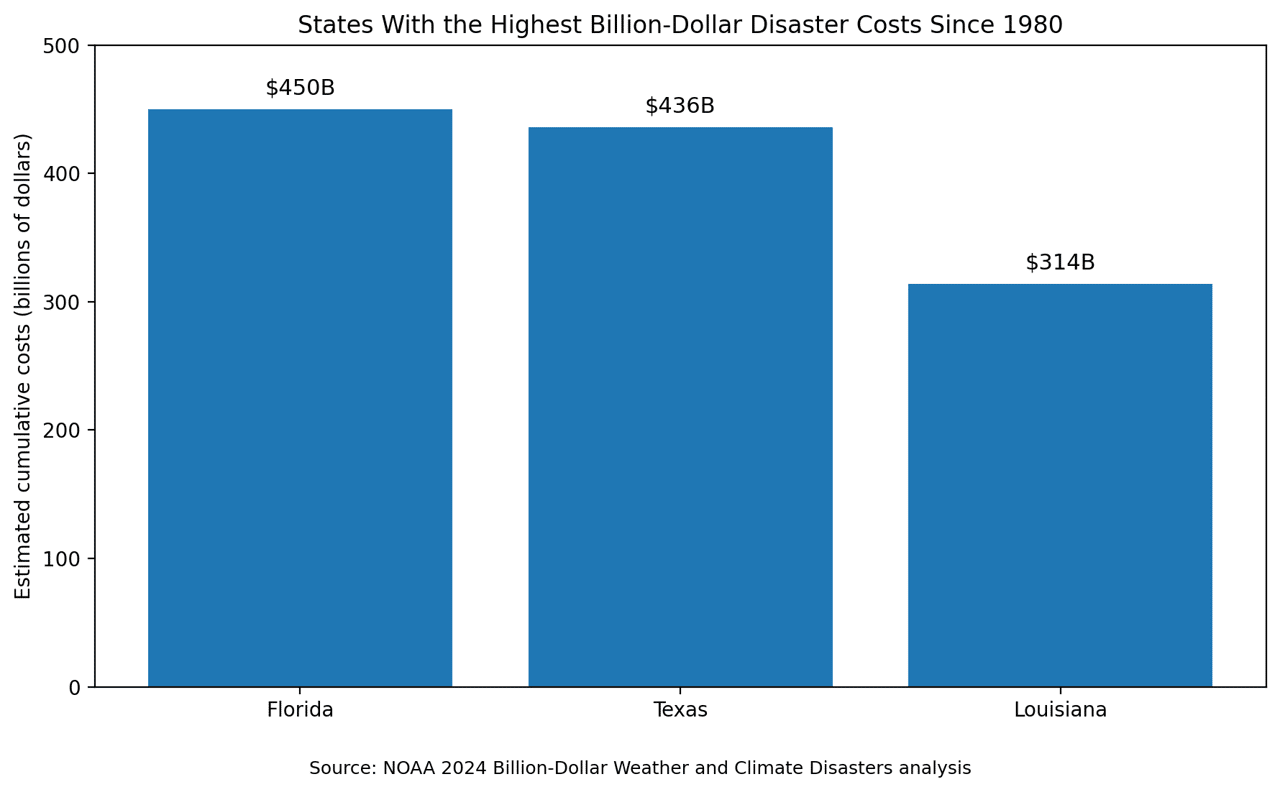
By state, the cumulative picture is concentrated in the Gulf and Southeast:
- Florida leads all states in total costs from billion-dollar disasters since 1980, at approximately $450 billion, driven largely by hurricanes.
- Texas ranks second, at approximately $436 billion, and has been affected by the highest number of billion-dollar disasters of any state since 1980.
- Louisiana ranks third, at approximately $314 billion in total costs.
Mokaram Injury Lawyers
Those figures come from NOAA’s 2024 billion-dollar disaster analysis, which also reported that the U.S. experienced 27 separate billion-dollar weather and climate disasters in 2024 alone, totaling $182.7 billion in damages, the fourth-highest annual total on record.
The Cities With the Highest Exposure to Storm Surge
Storm surge, the abnormal rise in seawater pushed inland by a hurricane’s winds, is identified by the National Hurricane Center (NHC) as the leading cause of hurricane-related deaths in the United States. The NHC uses its SLOSH (Sea, Lake, and Overland Surges from Hurricanes) model to simulate storm surge risk across the Gulf and Atlantic coasts under Category 1 through 5 scenarios. The agency updated its national storm surge risk maps in 2025, reprocessing Gulf and East Coast data to improve spatial resolution.
The NHC notes that storm surge is not limited to beachfront communities, with risk extending several miles inland in some areas.
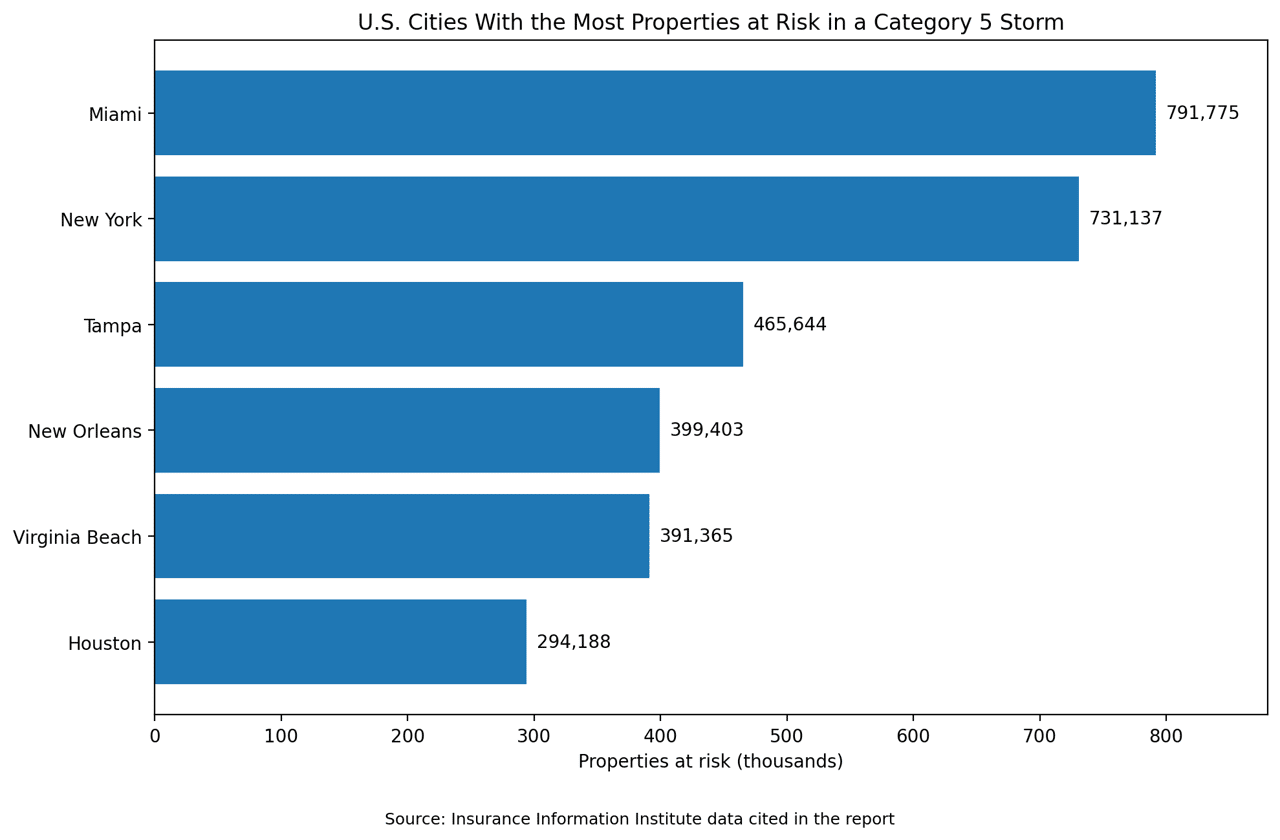
Among the metropolitan areas with the largest number of homes at risk from storm surge and hurricane winds, based on Cotality 2026 risk assessments, include:
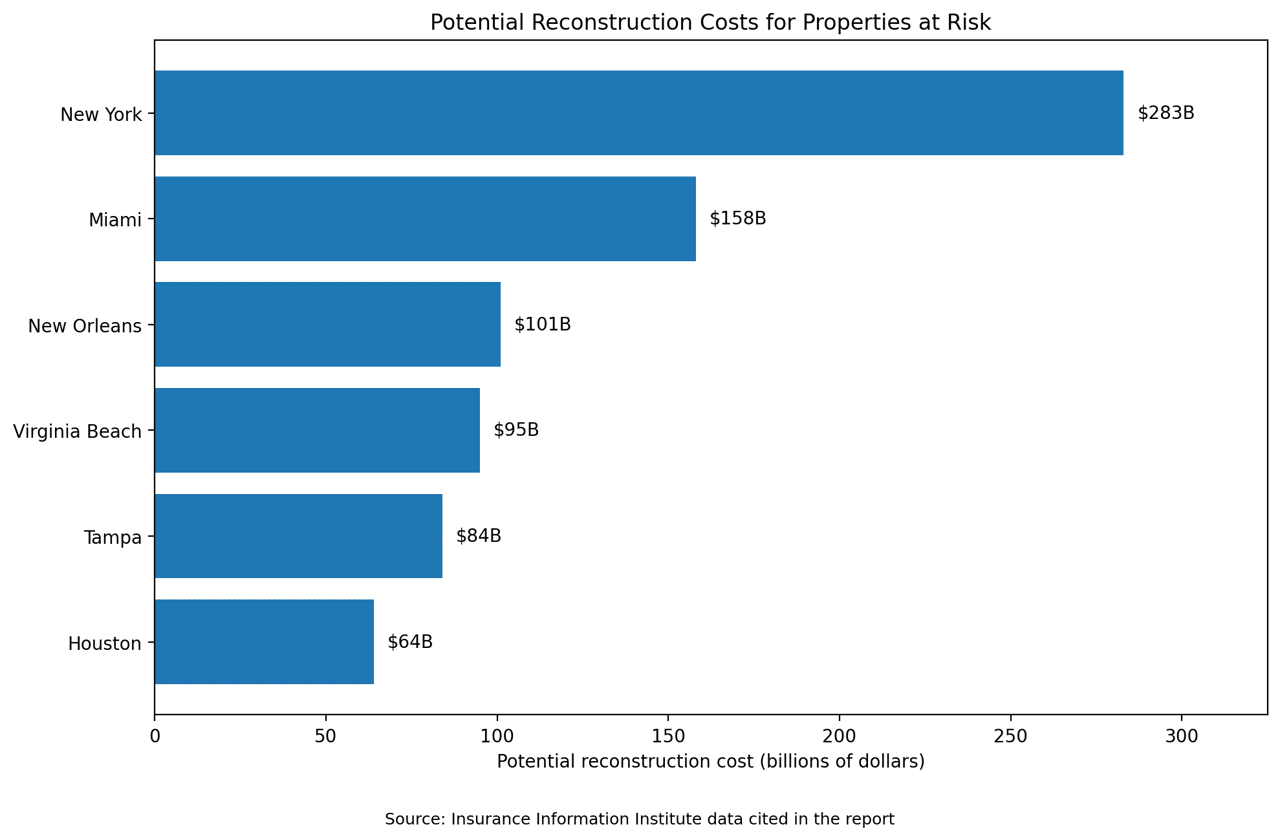
- Miami: Approximately 791,775 properties at risk from a Category 5 storm, with a potential reconstruction cost value of $158 billion. AccuWeather analysis of NOAA hurricane research data estimates Miami’s annual probability of hurricane impact at 16%, with a direct strike occurring on average every six to eight years.
- New York: Approximately 731,137 properties at risk, with a potential reconstruction cost of $283 billion. New York’s vulnerability is largely linked to storm surge, as demonstrated by Hurricane Sandy in 2012, which caused an estimated $19 billion in damage to the state.
- Tampa, Florida: Approximately 465,644 properties at risk, with a potential reconstruction cost of $84 billion.
- New Orleans: Approximately 399,403 properties at risk, with a potential reconstruction cost of $101 billion. More than 50% of the city sits below sea level, and AccuWeather analysis of NOAA data estimates its annual hurricane impact probability at 11%.
- Virginia Beach, Virginia: Approximately 391,365 properties at risk, with a potential reconstruction cost of $95 billion.
- Houston: Approximately 294,188 properties at risk, with a potential reconstruction cost of $64 billion.
Mokaram Injury Lawyers
Florida has the largest total number of homes with moderate or greater risk of hurricane wind damage at 8,178,843, with a reconstruction cost value of $2.32 trillion. The state also leads in storm surge exposure, with 2,414,132 homes at moderate or greater surge risk, according to 2025 risk data.
Mokaram Injury Lawyers
Historical Frequency: Which Cities See Storms Most Often
Beyond property exposure, historical storm tracking data provides insight into how frequently specific locations are affected. Based on NOAA hurricane research data analyzed by AccuWeather, using 126 years of hurricane track data:
- Miami and Key West, Florida: Each carries a 16% annual probability of hurricane impact, the highest among major U.S. cities. Key West is directly impacted by a hurricane on average every six years.
- Tampa, Florida: Has an estimated 11% annual probability of hurricane impact. The city’s location at the top of a funnel-shaped bay is associated with increased storm surge exposure.
- New Orleans: Also at 11%, with a hurricane making landfall within 50 miles on average every seven to 11 years.
Cape Hatteras, North Carolina, holds the record for the most hurricane and tropical storm contacts since 1871 in tracking data maintained by HurricaneCity.com, which draws on NHC historical archives.
The 2025 Season Outlook
NOAA’s 2025 Atlantic hurricane season outlook, released ahead of the June 1 season start, forecasts a 60% chance of an above-normal season. Forecasters projected 13 to 19 named storms, with six to 10 becoming hurricanes and three to five reaching major hurricane strength (Category 3 or higher). NOAA cited continued El Niño/Southern Oscillation (ENSO)-neutral conditions, warmer-than-average ocean temperatures, weak wind shear, and elevated activity from the West African monsoon as contributing factors.
The agency also noted that sea level rise is associated with increased storm surge impact from hurricanes, a trend documented in NOAA’s Fifth National Climate Assessment.
This story was produced by Mokaram Injury Lawyers and reviewed and distributed by Stacker.