
NMR reveals hidden electrolyte states for better batteries
GA, UNITED STATES, August 12, 2026 /EINPresswire.com/ -- Liquid electrolytes are often described like recipes: a salt,

Press Release Disclaimer: This is a press release distributed through the XPR Media network. It has not been independently verified by our newsroom.
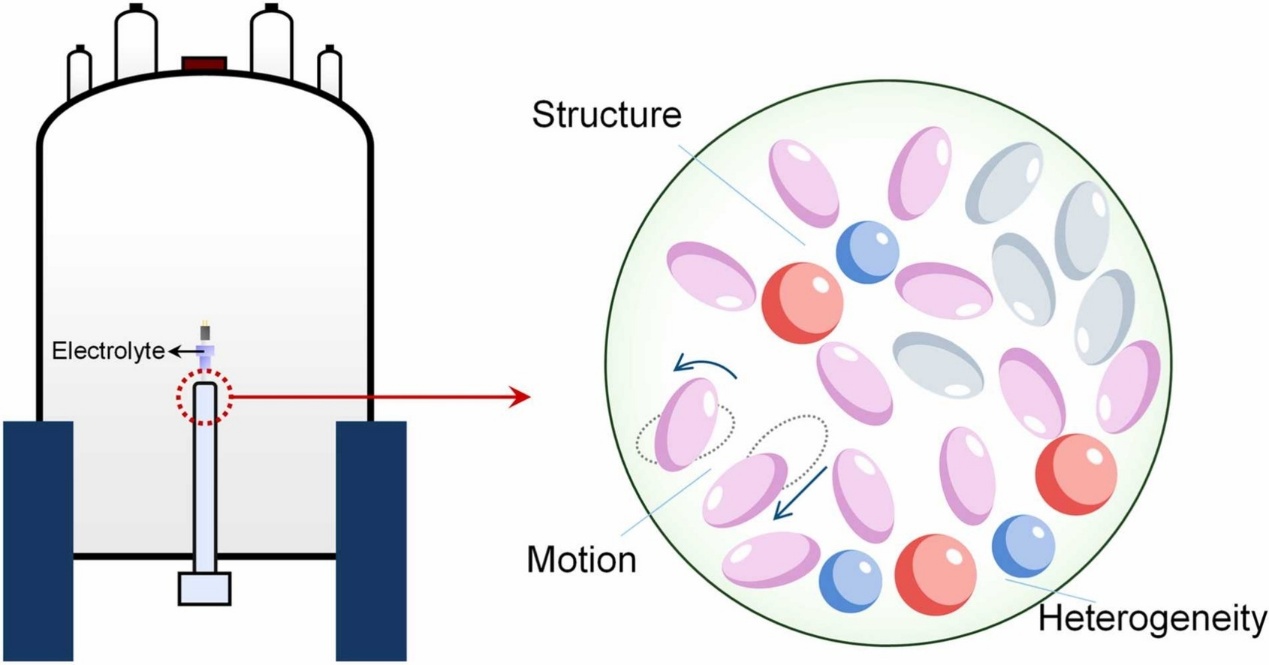

GA, UNITED STATES, August 12, 2026 /EINPresswire.com/ — Liquid electrolytes are often described like recipes: a salt, a solvent, an additive, and a concentration. Yet the chemistry that shapes battery lifetime, safety, and efficiency begins in a far more complex liquid environment. A new Perspective reframes battery electrolytes as evolving liquid states rather than fixed formulations, showing how nuclear magnetic resonance (NMR) can connect microscopic structure, microscopic motion, and dynamic heterogeneity. By revealing which local environments exist, how they move, and how multiple states coexist, this framework offers a clearer way to interpret electrolyte behavior and guide the design of more reliable batteries.
Battery performance depends strongly on the first chemical steps that occur where the electrolyte meets the electrode. These reactions influence the solid-electrolyte interphase (SEI), cathode-electrolyte interphase (CEI), charge transfer, parasitic chemistry, and long-term cycling stability. However, conventional electrolyte descriptions often rely on averaged properties or formulation labels that can miss important local differences. Similar recipes may produce different ion pairs, solvent-rich regions, salt-rich clusters, or slowly responding environments. Due to these issues, there is a need to study liquid battery electrolytes beyond formulation identity and average solvation structure.
The Perspective was authored by researchers from King Abdullah University of Science and Technology (KAUST), including the Materials Science and Engineering Program in the Physical Science and Engineering (PSE) Division and the Center of Excellence for Renewable Energy and Storage Technologies (CREST). Published (DOI: 10.1016/j.esen.2026.100077) online on May 26, 2026, in eScience Energy, the article presents nuclear magnetic resonance (NMR) as an integrated experimental framework for understanding how liquid electrolytes organize, move, and become heterogeneous before interfacial chemistry begins.
The article organizes electrolyte behavior into three connected layers. First, microscopic structure extends beyond the first solvation shell around ions. It includes ion pairing, aggregation, solvent-rich and salt-rich motifs, hydrogen-bond networks, and short-range molecular organization. Multinuclear NMR can follow these environments through chemical shifts, line shapes, and correlations from nuclei associated with cations, anions, solvents, additives, and coordinated water. Second, microscopic motion goes beyond diffusion. Exchange spectroscopy (EXSY), diffusion ordered spectroscopy (DOSY), and relaxation measurements can help separate local exchange, ion transport, molecular reorientation, and short-range rearrangement. Third, heterogeneity becomes important when one electrolyte formulation contains multiple local states or response regimes. Broad peaks, asymmetric signals, partially resolved resonances, and relaxation distributions can show that an electrolyte is not a uniform liquid, but a mixture of coexisting structural and dynamic populations. Together, these measurements help explain why nominally similar electrolytes can produce different interfacial outcomes and battery performance.
The authors said this perspective can help battery researchers avoid reducing electrolytes too early to one peak, one structure, or one transport value. They said NMR is valuable because it keeps structural, motional, and distributional information connected within the same formulation. Instead of asking only what an electrolyte is made of, the framework asks what local states are present, how quickly they renew, and which populations remain available to the electrode surface. This shift could make electrolyte design more chemically grounded and more relevant to practical battery operation.
The implications extend across lithium, sodium, zinc, magnesium, aqueous, organic, high-concentration electrolyte (HCE), and localized high-concentration electrolyte (LHCE) systems. More precise NMR-resolved descriptions could help researchers design formulations that balance ion transport, interfacial stability, and suppressed parasitic reactions. The Perspective also highlights future directions, including operando NMR under working battery conditions, interface-sensitive approaches such as magic angle spinning (MAS) NMR and dynamic nuclear polarization (DNP)-enhanced NMR, and closer integration with molecular simulation and artificial intelligence (AI)-based analysis. These approaches may help bridge bulk liquid-state measurements with the interfacial chemistry that ultimately controls battery function.
DOI
10.1016/j.esen.2026.100077
Original Source URL
https://doi.org/10.1016/j.esen.2026.100077
Funding information
This work was supported by King Abdullah University of Science and Technology (KAUST) − Center of Excellence for Renewable Energy and Storage Technologies (CREST) under award number 5937.
Lucy Wang
BioDesign Research
email us here
Legal Disclaimer:
EIN Presswire provides this news content “as is” without warranty of any kind. We do not accept any responsibility or liability
for the accuracy, content, images, videos, licenses, completeness, legality, or reliability of the information contained in this
article. If you have any complaints or copyright issues related to this article, kindly contact the author above.

Media gallery

